

Dubai Announces GLYDWAYS: A New Era of Autonomous Urban Mobility
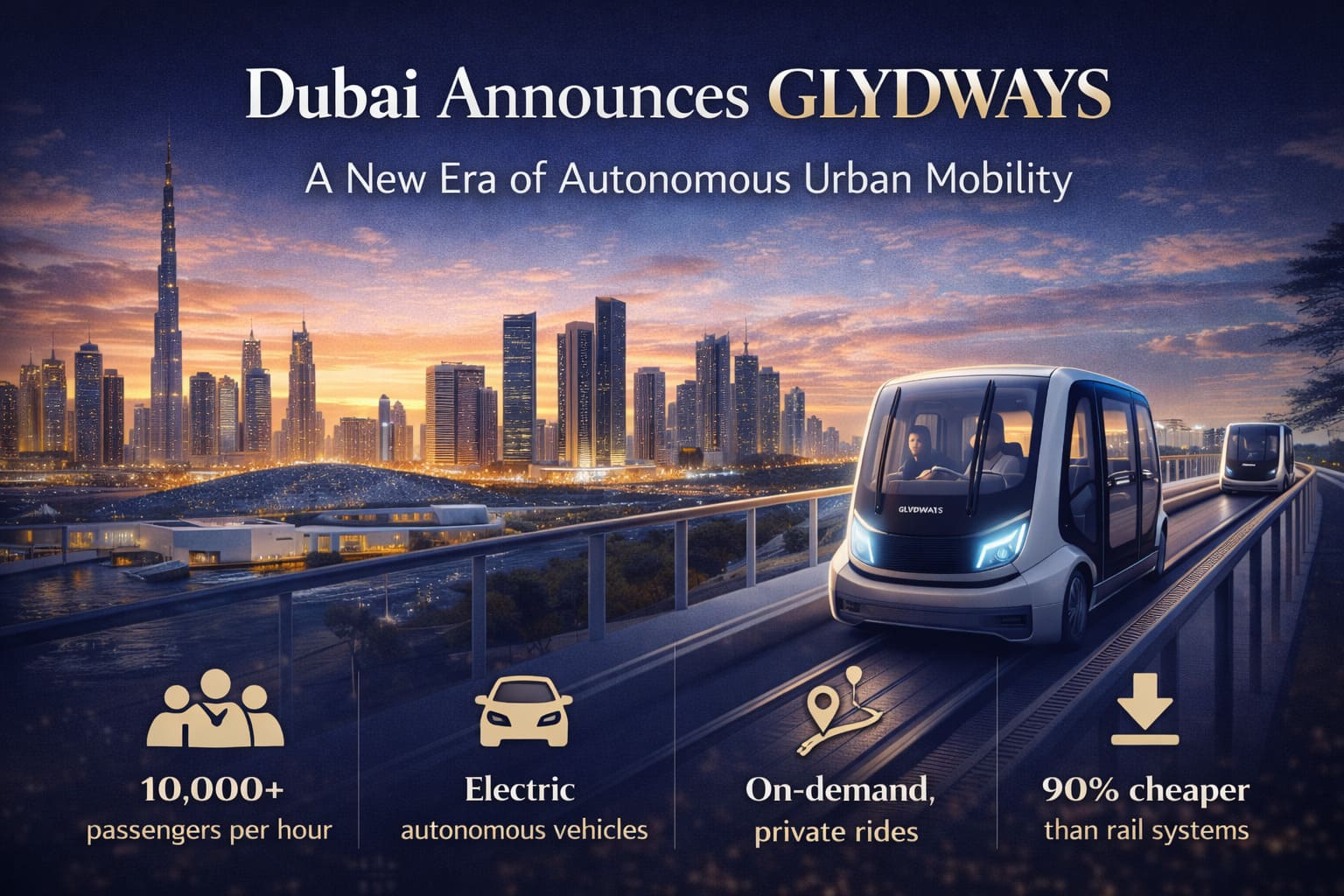
Dubai has unveiled GLYDWAYS, an innovative autonomous transport system designed to redefine how cities move people efficiently, affordably, and sustainably. The announcement was made by the Dubai Roads and Transport Authority (RTA) during the World Governments Summit 2026, reinforcing Dubai’s position as a global leader in next-generation urban mobility.
GLYDWAYS is built around a simple but transformative idea: replacing large, centralized transport systems with small, electric, autonomous vehicles operating on dedicated guideways, delivering private, on-demand journeys without traffic interference.
Revolutionizing Urban Transport
At full capacity, the GLYDWAYS system is designed to carry more than 10,000 passengers per hour in each direction, a throughput comparable to traditional mass transit systems — but achieved through decentralized, flexible vehicle movement rather than large trains or buses.
Unlike conventional rail or metro infrastructure, GLYDWAYS operates on narrow, elevated or dedicated tracks, minimizing land use, visual impact, and disruption to existing road networks. This allows the system to be integrated into dense urban areas without adding congestion or requiring large-scale infrastructure overhauls.
Vehicle Technology and Performance
Each GLYDWAYS vehicle is fully autonomous and electric, offering:
-
Capacity for 4 to 6 passengers
-
Operating speeds of up to 50 km/h
-
A range of up to 250 kilometers on a single charge
The vehicles are designed for point-to-point travel, eliminating the need for transfers, shared rides, or waiting for scheduled services. Passengers experience a private, on-demand journey, unaffected by road traffic conditions.
A Disaggregated Public Transit Model
GLYDWAYS represents a shift toward a disaggregated public transport system, where mobility is delivered through many small, intelligent units rather than centralized fleets. This approach increases resilience, improves passenger experience, and allows the system to scale incrementally as demand grows.
By operating independently from road traffic, GLYDWAYS removes common urban pain points such as congestion delays, overcrowding, and inflexible routes — offering a model well-suited for modern, high-density cities.
Cost Efficiency and Scalability
One of GLYDWAYS’ most significant advantages is cost. The system is estimated to be up to 90% cheaper than traditional rail infrastructure, both in construction and long-term operation. This dramatically lowers barriers to deployment, making it feasible to expand coverage quickly and adapt routes based on demand.
Lower costs also mean greater accessibility, allowing cities to deliver advanced mobility solutions without the financial burden typically associated with heavy rail projects.
The Bigger Picture for Dubai
GLYDWAYS aligns with Dubai’s broader smart-city and sustainability goals, supporting reduced emissions, efficient land use, and future-ready infrastructure. More than a transport system, it represents a new urban mobility philosophy — one that prioritizes flexibility, passenger experience, and scalable innovation.
As cities worldwide search for alternatives to congested roads and expensive rail systems, Dubai’s GLYDWAYS initiative positions the emirate at the forefront of autonomous, electric, and people-centric transport solutions.