

Buying Off-Plan Property in Dubai as a Non-Resident: Legal Process, Costs, and Residency Options
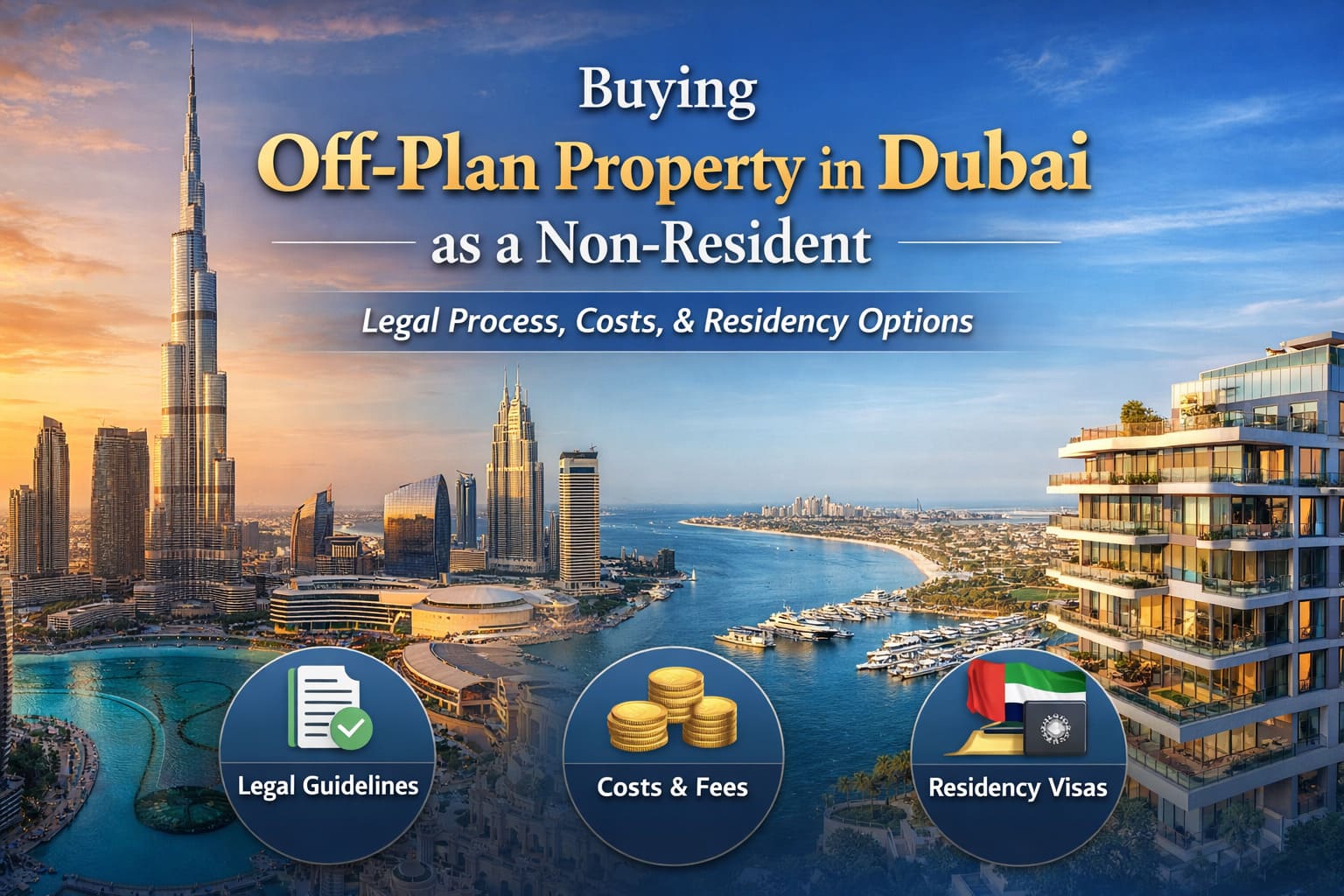
Buying Off-Plan Property in Dubai as a Non-Resident
Dubai continues to attract international buyers looking for strong capital growth, flexible payment plans, tax-efficient ownership, and long-term residency opportunities. For non-residents, buying off-plan property in Dubai can be a highly attractive investment route, but it is important to understand the legal framework, purchase process, transaction costs, and visa implications before committing.
The good news is that Dubai has built one of the most transparent and regulated off-plan property markets in the region. Foreign buyers can purchase in designated freehold zones, payments are protected through mandatory escrow regulations, and ownership rights are recorded through the Dubai Land Department’s Oqood system until the title deed is issued at handover.
Whether you are buying for capital appreciation, rental returns, future relocation, or residency eligibility, understanding each stage of the process is essential. From selecting the right freehold area to verifying the developer, reviewing the SPA, budgeting for DLD and admin fees, and planning your exit before handover, every step plays a role in protecting your investment.
This guide explains exactly how non-resident buyers can purchase off-plan property in Dubai, what documents are required, how remote purchases work, what costs to expect, and how property ownership may qualify you for UAE residency options such as the Property Investor Visa or the Golden Visa.
Where Foreigners Can Buy Property in Dubai
Foreign buyers can purchase property in Dubai in designated freehold areas, where full ownership rights are available. These zones include many of Dubai’s most established residential and investment-focused communities.
Some of the most in-demand freehold areas include:
- Dubai Marina
- Downtown Dubai
- Business Bay
- Dubai Hills Estate
- Dubai Creek Harbour
- Palm Jumeirah
- Jumeirah Village Circle
- Dubai Islands
- Palm Jebel Ali
Before reserving any unit, buyers should verify that the project is officially registered with the Dubai Land Department (DLD) and regulated by RERA. This helps confirm that the development is operating under Dubai’s official legal framework.
Step by Step: How to Buy Off-Plan Property in Dubai as a Non-Resident
Step 1: Choose the Property and Reserve the Unit
The process begins by selecting the project, reviewing the payment plan, checking the developer’s reputation, and understanding the project’s location and demand drivers.
Once the buyer decides on a unit, a reservation fee, typically around 5% to 10%, is paid to secure it temporarily while documents are prepared.
Before paying anything, buyers should verify:
- Developer RERA registration
- Project registration with the DLD
- Escrow account details
- Official project listing through the Dubai REST app or DLD portal
This is one of the most important stages because it confirms that the project is legally approved and protected under Dubai’s off-plan regulations.
Step 2: Review and Sign the Sales and Purchase Agreement (SPA)
After reservation, the developer issues the Sales and Purchase Agreement (SPA). This is the main contract between the buyer and developer.
The SPA typically includes:
- Payment schedule
- Construction milestones
- Handover timeline
- Delay and grace period clauses
- Cancellation terms
- Assignment or resale conditions before handover
Because each developer may structure contracts differently, many international buyers choose to have the SPA reviewed by a property lawyer before signing.
Step 3: Pay the Down Payment
After signing the SPA, the buyer pays the first installment according to the agreed schedule. For many off-plan projects, this is usually around 10% to 20% of the property value, depending on the launch structure.
A critical rule here is that all payments must go into the project’s regulated escrow account, not the developer’s operating account. This is one of the main protections available to buyers in Dubai’s off-plan market.
Step 4: Oqood Registration
Once the initial payment is made, the developer registers the transaction through the Oqood system with the Dubai Land Department.
The buyer then receives an Oqood certificate, which acts as the legal ownership record during the construction stage. This protects the buyer’s rights and ensures the same unit cannot be sold to someone else.
The 4% DLD registration fee is usually paid at this stage, along with the relevant DLD admin charges.
Step 5: Make Construction-Linked Installment Payments
After Oqood registration, the buyer continues paying according to the project’s installment schedule.
In Dubai’s escrow framework, funds are not freely released to the developer. Instead, money is released from the escrow account only after:
- Construction milestones are achieved
- An independent engineering consultant verifies progress
- The DLD approves the release
This system adds an important layer of protection and reduces misuse of buyer funds.
Step 6: Handover and Title Deed Issuance
Once construction is completed and the buyer makes the final payment, the property is handed over.
At this point:
- Final inspections are completed
- The Oqood record is converted
- The title deed is issued by the Dubai Land Department
The title deed becomes the permanent ownership document for the completed property.
Buying Property in Dubai Remotely
Non-resident buyers do not need to be physically present in the UAE to complete an off-plan purchase. In many cases, the entire process can be handled remotely.
The basic documents usually required include:
- Valid passport
- Proof of address
- Source-of-funds declaration
- Additional KYC documents if requested
- Notarised Power of Attorney if a representative is acting on the buyer’s behalf
If using a Power of Attorney, it must usually be notarised and attested correctly, then translated into Arabic if required.
A qualified and verified RERA-registered agent can assist with:
- Shortlisting projects
- Coordinating viewings remotely
- Reservation and SPA processing
- Escrow verification
- Oqood registration
- Payment schedule follow-up
- Handover support and snagging coordination
Buyers should always verify the agent’s registration through the DLD or Dubai REST app.
What It Costs to Buy Off-Plan Property in Dubai
In addition to the purchase price, buyers should budget for several mandatory costs. For cash buyers, total purchase-related costs typically range from around 7% to 9% of the property price, while mortgage transactions may involve additional financing costs.
Typical Cost Items
- DLD fee: 4% of purchase price
- DLD admin registration fee: AED 2,000 for properties under AED 500,000 or AED 4,000 for properties above AED 500,000, plus VAT and knowledge fees
- Agent commission: usually 2% + VAT, if applicable
- Title deed issuance: approximately AED 250 to AED 580 at handover
It is also important to note that Dubai does not charge annual property tax. However, owners should still account for:
- Service charges
- Building or community maintenance
- Insurance
- Standard repair and upkeep costs
In some launches, developers may also offer promotions such as covering the 4% DLD fee.
Mortgage Options for Non-Resident Buyers
Foreign buyers can access mortgage financing in Dubai, but requirements are generally stricter than those for UAE residents.
For non-residents, lenders may require:
- Strong overseas income documentation
- International credit history checks
- Bank-approved property valuation
- Larger down payments than resident buyers
For ready properties, non-resident buyers are typically offered lower loan-to-value ratios. For off-plan purchases, financing limits are stricter, which is why many foreign investors choose cash purchases or use partial financing after completion.
Islamic home finance options such as Murabaha and Ijara are also available through several UAE banks.
Many international buyers work with a UAE mortgage broker to compare lenders, simplify documentation, and manage the application remotely.
Residency Options Linked to Property Ownership
One of the strongest attractions for foreign buyers in Dubai is that property ownership can lead to UAE residency.
Property Investor Visa
Buyers may qualify for a 2-year investor visa from AED 750,000, but this usually applies to completed properties with title deeds. Off-plan units generally do not qualify until handover.
UAE Golden Visa
Buyers may qualify for a 10-year Golden Visa if the property value reaches AED 2,000,000 as assessed by the DLD.
This can apply to:
- Off-plan properties
- Completed properties
- Mortgaged properties
- Fully paid properties
In some cases, multiple properties can be combined to reach the threshold, provided they are registered in the applicant’s name.
Can You Resell an Off-Plan Property Before Handover?
Yes. Dubai allows off-plan investors to sell before completion through a process known as assignment.
However, developers usually require the buyer to have paid a certain percentage of the property value before granting approval. This is often around 30% to 40%, depending on the project.
The resale process usually includes:
- Obtaining a No Objection Certificate (NOC) from the developer
- Paying the applicable NOC fee
- Registering the transfer through Oqood
- Transferring the remaining payment obligations to the new buyer
This gives investors flexibility if they want to exit before completion and capture appreciation during the construction period.
How Dubai Law Protects Off-Plan Buyers
Dubai’s off-plan market is built on a structured legal framework designed to protect buyers.
Every approved off-plan project must maintain a dedicated escrow account with a licensed UAE bank. Buyer payments are deposited into this account and released only when verified construction milestones are achieved.
This means:
- Funds cannot be freely used by the developer
- Construction progress is independently monitored
- Ownership is protected through Oqood registration
- Buyers have legal recourse in case of delays or project cancellation
If a developer delays beyond the SPA grace period, buyers may have options such as:
- Requesting compensation
- Cancelling the contract
- Seeking a refund under the applicable framework
- Filing a complaint with the Dubai Land Department
This legal structure is one of the main reasons Dubai continues to attract international off-plan investors.
Final Thoughts
Buying off-plan property in Dubai as a non-resident can be a smart move for investors seeking capital growth, flexible payment plans, and future residency options. But like any major investment, it requires proper due diligence.
The strongest buyers are not just choosing a project — they are evaluating the developer, the legal structure, the payment schedule, the location’s long-term growth drivers, and the exit strategy before handover.
Dubai offers foreign investors access to freehold ownership, transparent registration systems, protected escrow structures, and residency pathways that make the market especially attractive on a global level.
For non-residents, the opportunity is real — but the advantage comes from understanding the process properly before signing.