

UAE Taxes Explained: The Complete Guide to Income, Property, VAT & Corporate Tax (2026 Update)
The UAE Taxes
When people hear about the United Arab Emirates, they often ask one simple question:
“Is the UAE really tax-free?”
The short answer: almost — but with important details.
The UAE has one of the most investor-friendly tax systems in the world, designed to attract talent, capital, and long-term wealth — not to drain it.
This guide explains UAE taxes clearly, simply, and without confusion, covering:
-
Personal income
-
Capital & inheritance
-
VAT
-
Corporate tax
-
Property tax (the one everyone asks about)
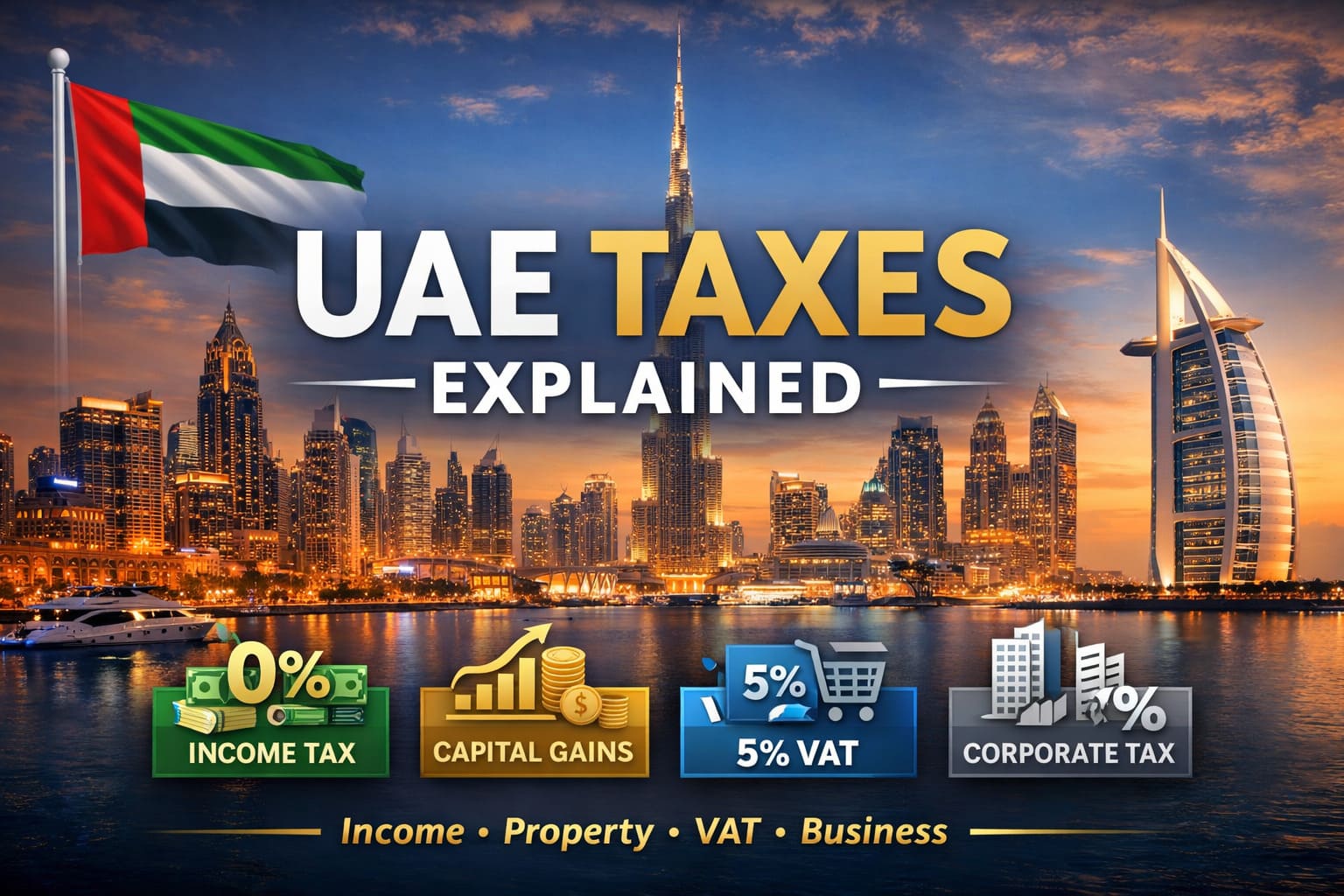
1. Personal Income Tax in the UAE
0% — Fully Tax-Free
The UAE does not impose personal income tax.
This means:
-
No tax on salaries
-
No tax on wages
-
No tax on freelance or personal income
What you earn = what you keep.
Whether you are:
-
An employee
-
A business owner paying yourself a salary
-
A consultant or remote worker
Your personal income is not taxed by the government.
2. Capital Gains, Wealth & Inheritance
Still 0% for Individuals
For individual residents and investors, the UAE offers:
-
No capital gains tax
-
No wealth tax
-
No inheritance tax
This applies to:
-
Property resale gains
-
Investment profits
-
Long-term asset holding
-
Family wealth transfer
Your assets remain yours — across generations.
This alone makes the UAE extremely attractive compared to Europe, the UK, and many parts of Asia.
3. VAT (Value Added Tax)
5% — One of the Lowest Globally
The UAE introduced VAT in 2018, but at a very low rate.
Key points:
-
VAT is 5%
-
Applies to most goods and services
-
Paid by the consumer, not directly “earned income”
-
Businesses must register if turnover exceeds AED 375,000 annually
Compared to:
-
UK: 20%
-
Europe: 19–25%
The UAE’s VAT remains minimal and predictable.
4. Corporate Tax in the UAE
Business Profits Only
In 2023, the UAE introduced federal corporate tax — but only on business profits, not individuals.
How it works:
-
0% on profits up to AED 375,000
-
9% on profits above AED 375,000
Important clarifications:
-
Salaries are not taxed
-
Personal income is not taxed
-
Many Free Zone companies can still qualify for 0% corporate tax, if conditions are met
This system targets large, profitable businesses — not employees or small startups.
5. Property Tax in the UAE (Very Important)
No Annual Property Tax
This is where the UAE truly stands out — especially for real estate investors.
In Dubai and most of the UAE:
There is:
-
No yearly property tax
-
No council tax
-
No capital gains tax on resale (for individuals)
What does exist:
-
A one-time 4% Dubai Land Department transfer fee when buying
-
Minor registration and admin fees
Once you own the property:
No recurring tax pressure.
This is a major reason global investors shift capital into UAE real estate.
6. Why Global Investors Care About UAE Taxes
The UAE tax structure is not accidental — it is strategic.
Investors benefit from:
-
High rental yields
-
Zero annual property taxes
-
Strong tenant demand
-
Clear ownership and legal frameworks
-
Easy repatriation of profits
Instead of taxing ownership, the UAE rewards long-term capital participation.
Your property doesn’t just sit — it works harder for you.
Final Thoughts: Why the UAE Attracts Smart Money
The UAE doesn’t focus on taxing income.
It focuses on attracting capital, talent, and growth.
That’s why:
-
Entrepreneurs relocate here
-
Investors park long-term wealth here
-
Global businesses expand here
Smart money follows smart systems.